No one prepared me for the transition to my son’s two-year-old classroom. I prepared him—I invested time and patience, and I supported him in the ways I thought he needed. But no one prepared me. Let me explain myself: my son has been in daycare since he was a baby, and during that time, I noticed how his needs were met with special accommodations, like contact naps and the option to bring his own meals. The 1:4 teacher-to-child ratio allowed for individualized care and attention. But now, in the two-year-old classroom, that sense of nesting has changed.
The other day, I dropped my son off at daycare, and when we arrived, a dance party was already underway. He received a warm “Good morning!” from his teachers, but needed a few minutes to adjust. Soon found a train that caught his interest. He was content enough to wave me “goodbye” and let me leave. But he didn’t join the group activity right away; instead, he played by himself. And that unsettled me. He was fine—there were no tears—but I felt a tightness in my chest. As I tried to understand my discomfort, I finally put it into words: for the first time, I saw that my son was just one among many.
Being just one of the children means he won’t receive any special treatment. His needs and wants will be as important as those of every other child in the group. It means he will have to wait, face frustration, and not always get what he wants. I called my husband, a bit desperate, and I even questioned our decision to keep our child in daycare. And wisely, he responded: “He will always be the most important person to us, but not to the world—and that’s a good thing.”
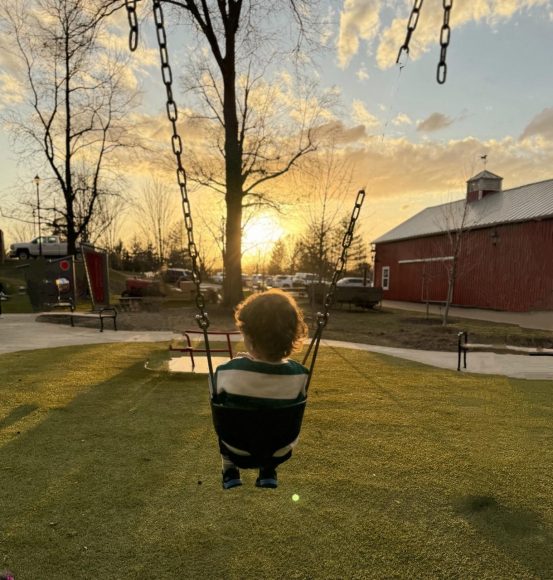
From where I come from, we have an expression that would roughly translate to English as “give yourself the gift of unimportance” or “don’t overestimate your importance”. While some might see it as dismissive or belittling, when we truly understand what unimportance means, it can be a relief. Clinging to the idea that we are the center of the world is exhausting. This fantasy often goes hand in hand with society’s relentless demands—to be the best, to succeed, to achieve recognition, to never make mistakes, etc. This mindset is deeply tied to capitalist and neoliberal ideals, shaping not only our personal ambitions but also the way we parent the next generation.
Most of the time, we are so absorbed in our own importance that we don’t even realize it. For instance, when we assume someone’s actions were meant to affect us personally, we’re, in a way, placing ourselves at the center of their decisions. We consider ourselves so important that the other person could only have acted with the intention of targeting us. We overlook the fact that other people have their own concerns and struggles, and sometimes, their actions were never about us to begin with – or at the very least, it was never just about us.
Another example is when we fear that every word or action of ours might cause a trauma in someone else, or an irreparable harm to a relationship, leading us to suppress our feelings, keeping them hidden so that no one sees, hears, or notices them. Ironically, this act of self-censorship also stems from an inflated sense of self-importance.
It’s important to clarify that embracing unimportance doesn’t mean being ignored, rejected, or insignificant. It’s not about erasing oneself, but rather about shifting away from the illusion of centrality. This shift allows us to engage with the world more openly, without the burden of constant validation or the exhausting need to control every outcome. Returning to my son’s story, I realized that, for him, being “just one” in his classroom might actually be a gift. In a space where he isn’t constantly watched, where his every move isn’t anticipated or accommodated, he is free to explore who he is beyond the reflection of my expectations. It grants him the opportunity to assert himself—not in opposition to others, but in relation to them. He can develop confidence not because he is the most special, but because he is capable. He can set boundaries, navigate friendships, experience frustration, and make mistakes without feeling like the weight of the world—or my gaze—is pressing upon him.
Letting go of the fantasy of being the center of everything is liberating. Carrying the expectation of constant significance is an impossible task, one that leads to anxiety, perfectionism, and suffering. And when we release this weight, we open ourselves to something far more valuable: the ability to exist without conditions. We are not responsible for everything, nor do we need to be. In a world that demands we prove our worth at every turn, embracing unimportance is an act of quiet revolution. It is a rejection of the idea that our value is tied to how much space we take up. You don’t have to be so important all the time—you can simply be.