Teaching your kids to ride a bike is one of those parenting rites of passage that looks charming in movies … but in real life? It’s often sweaty, stressful, and full of trial and error. With three kids (ages 6, 6, and 9), I’ve learned that no two journeys are the same — and that sometimes, this milestone takes a lot longer (and a lot more patience) than you expect.
Why Does It Feel So Hard Right Now?
I’ve chatted with other moms, and I know this is not something I feel alone in a bubble. The struggle is REAL and here are a few reasons why teaching your kids to bike today may be even more challenging than it was when we were kids.
- Kids today have endless options for entertainment — bikes don’t always feel “cool” compared to screens or organized sports. Getting them to practice may not feel easy.
- Fear plays a big role. Many kids are scared of falling, and that fear can stop them from pedaling even when they’re so close.
- Parents are balancing multiple kids at different stages (I know this firsthand — trying to teach one while the others wait is tough).
Learning to Bike Without Training Wheels – Tips & Tricks That Actually Help
All kids are different and there is no one-size-fits-all approach. Here are a few tips I wish I knew earlier when I started teaching my kids to ride.
-
Start early & practice balance before pedaling.
If I could do it all over, a balance bike would be the first bike I would buy for my kids. These are perfect for toddlers. Have them scoot, coast, and put their feet down to build confidence.
-
Skip training wheels if you can.
Training wheels are great to build leg muscle and stamina but using them too long makes it harder to transition to a 2-wheeler. Looking back, I wish I had started teaching them to ride without training wheels in preschool.
-
Smaller bikes & lower seats are better for learning.
When learning to ride on their own, it’s important for your kids to be able to fully plant their feet on the ground. This means that a smaller bike, perhaps one that looks way too small, will be better for learning. Lowering the seat can also help as you transition. You can offer a larger bike once they get the hang of it.
-
Make sure you have the right equipment.
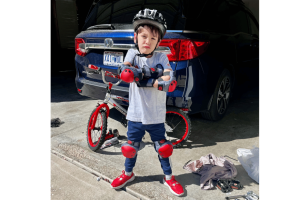
A proper fitting helmet is a must, along with knee & elbow pads. Wrist guards or gloves are a bonus! Make sure your kids understand that falling is just part of learning and that all this equipment protects them from injury.
-
Try the “Towel Method” for balance.
Rather than spending what seems like forever hunched over, balancing your kids teetering 2-wheeler, try the towel method instead. Essentially, loop a beach towel under their arms or chest to give them lift and stability without wrecking your back. The technique found in this Instagram video was a game changer for my daughter, I only wish I had seen it earlier.
-
Short and sweet sessions.
Don’t push it for hours — keep it fun and low-pressure. I found myself getting frustrated with my kids when they wanted to quit too quickly … do your best to stay upbeat, positive and go with the flow.
-
Model bravery & be prepared for boo-boos.
Kids pick up on our energy. Celebrate small wins and laugh off the falls. I always keep band-aids in the car or nearby when my kids are on their bike. That way if there is a small spill, we can just bandage up that boo-boo and carry on.
-
Choose the right setting.
Flat, paved trails are key (bonus points if there’s a playground for breaks). More on that below!
Flat Paved Paths for Bike Riding in STL
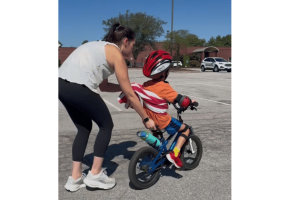
If your driveway is anything like mine, it doesn’t make learning easy. With bumps and slants in and around the neighborhood, I found driving my kids somewhere specifically for bike riding made it easier on them (albeit harder on me). Below is a list of flat trails that will make it easier on new riders, although any flat parking lot will do! We often biked around our elementary schools parking lot on weekends.
- Central Park (Chesterfield) – Wide, smooth paths around the lake, bathrooms, and a great playground up the hill. Park near the YMCA (not near the playground!)
- Creve Coeur Lake Park (Creve Coeur) – Flat loops, lake views, beach access, and plenty of space.
- Tilles Park (Ladue) – The short, paved loops around the park are easy to manage, and the multiple playgrounds, restroom facilities, and easy parking make it super convenient.
- Meramec Greenway near Simpson Park (Valley Park)– The Meramec Greenway offers some of the flattest bike paths in St. Louis, and the trailhead at Simpson Park is especially family-friendly. With shaded stretches along the river, it’s a calm spot to practice pedaling. The park also has bathrooms, parking, and a playground—making it a win for both kids and parents.
- Forest Park (Central West End/St. Louis)– Try the loop around the Grand Basin for a short, scenic ride, or hop on the dual path (near the Muny) for a little more space. With bathrooms, playgrounds, and plenty of parking nearby, Forest Park makes bike riding feel like an adventure in the city.
My Personal Journey to Teach My Kids to Bike
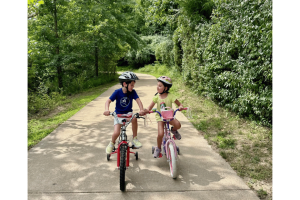
Teaching your kids how to ride a bike is one of those core childhood memories—equal parts exciting, wobbly, and unforgettable. Personally, teaching the kids how to ride a bike has been a tougher-than-expected rite of passage. My 3 kids are all at different stages of learning and each of their journeys has been unique.
Benji
I started working with my now 9-year-old when he was 6 and in first grade. I’ll never forget the struggles we faced building his confidence and my own. We had to backtrack and get him comfortable on 2 wheels using a balance bike. I also lowered the seat on this bike so that he would sit low and feel the ground. It wasn’t until he was 7.5 and in second grade that he finally took to bike riding without crashing and burning. Now at age 9, he enjoys riding his bike and loves showing off his skills to his younger brother and sister.
Zoe
My 6-year-old daughter is definitely the most athletic in the family. I thought she would take to bike riding much quicker than her older brother. Boy, was I wrong. She certainly was physically capable but the fear that rode alongside her made it ever more challenging. It wasn’t until I used the towel method (see above), 51 weeks after the training wheels came off, that things finally clicked. The towel gave her the confidence she didn’t need me to hold on. She is still getting used to the feeling of riding without help and needs me near her at all times, just in case.
Julian
My 6 year-old-son is just beginning his 2-wheel journey as of the end of this September. I was the most nervous about teaching him to ride as he is the most likely to get injured (see article about the monkey bars incident … ). But surprisingly, the progress he made on our first weekend was greater than I was expecting. I won’t get too ahead of myself here, because I know we still have a long and bumpy road ahead, but I am also feeling a bit more optimistic and confident in my own skills now that I’ve done it with 2 other kids. I see the light at the end of this tunnel and I look forward to the day when we can all ride together.
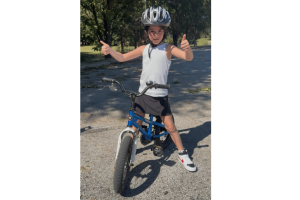
Teaching my kids to bike has certainly been an experience for the books. I’ve felt so many emotions on this journey so far – from fear to guilt to exhaustion. And now that 2 out of 3 kids are officially bike riding on their own, I’m feeling a growing sense of pride and accomplishment – not just for them but also for myself.
Maybe your kid will learn in a day. Maybe it will take months or even years like it has so far for me. Either way, you’re not failing. You’re giving your child confidence and independence — even if you’re still running alongside the bike whispering, “just keep pedaling.”
For more STL resources on fun fitness, delicious dining & finding balance as a mom, check out the author’s blog www.fitnessfoodiestl.com